01
Test automation is the day job, not a side skill
The alliance is staffed by engineers who have designed verification fixtures and executed protocols on Class II and Class III programs.
V&V 10x
Automated fixtures, AI-drafted protocols and reports formatted to your SOP, and a named engineer signing off on every method call — in one fixed-price package.
AI-drafted · evidence-cited · human-reviewed
The alliance is staffed by engineers who have designed verification fixtures and executed protocols on Class II and Class III programs.
Protocols and reports are generated into your document templates, not ours. Method selection and sample-size rationale are drafted by AI against the applicable standard, then reviewed and signed by a named engineer before anything reaches you.
Instrumented fixtures write structured data files that feed the draft report directly. The transcription step between the bench and the document — the step that generates data-integrity findings — is removed.
VER-01
Requirements or design-input list, current test plan or protocol drafts, and your protocol and report templates. Under NDA before anything moves.
VER-02
Every requirement is mapped to a verification method, an acceptance criterion, and a sample-size rationale. Gaps, untestable requirements, and unjustified criteria are scored by risk to the schedule.
VER-03
A named engineer reviews every AI-drafted method call and rationale, corrects it, and signs the review record. Findings you disagree with are marked as such rather than removed.
VER-04
A one-hour walkthrough of the scored gap table, the recommended test plan, and what it would take to execute it — with us, or with your own bench.
Closes the verification loop: plan, protocols, fixture data and report as one chain, with a human review gate before anything ships.
A rendered preview of the intended interface. Not running software.

Watch it run 1:08
A rendered preview. The video says it out loud in its second line: nothing here is a working system yet.
Edited before publishing: Final line trimmed from the recording.
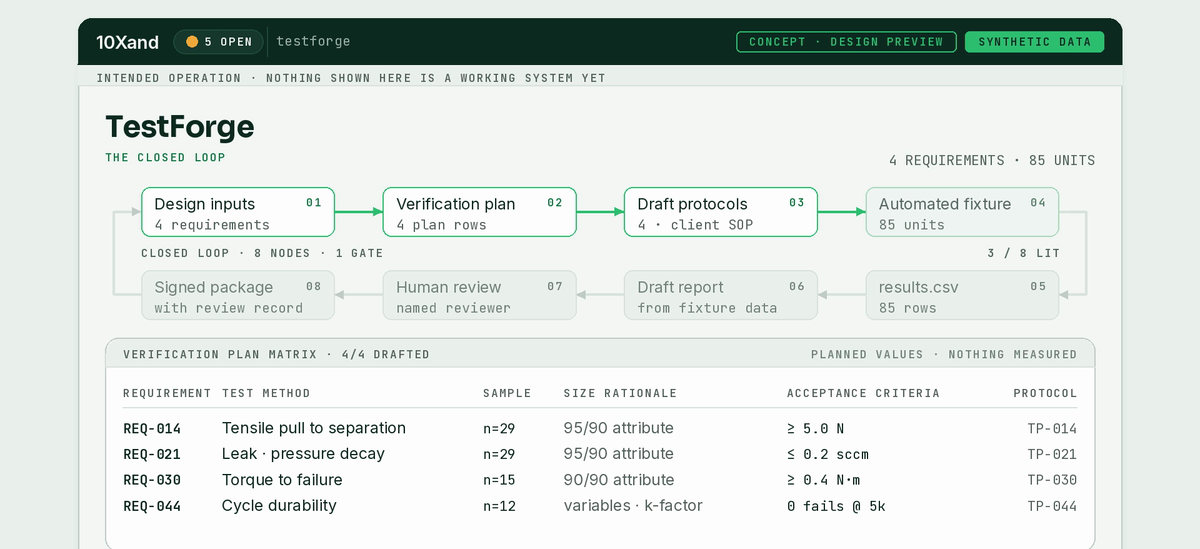
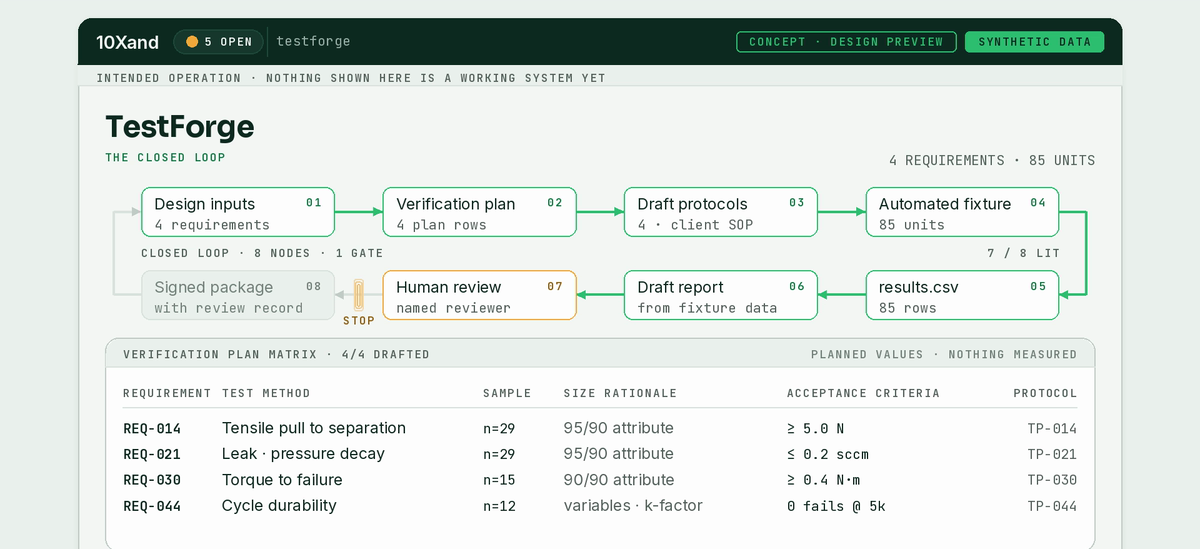
TOOL-03 Concept preview — nothing shown here is a working system yet, and the capture says so in its own chrome. The matrix carries planned values, not measurements.
The offer
This is a new service line and we are pricing it to learn: a fixed fee, quoted within 48 hours of the scoping review.
Intake is limited. We run a small number of scans concurrently so the engineer who signs your method calls is the one who made them. If the scope is larger than one device and one requirements set, we say so at the review rather than after.
One device, one requirements set, one week from kickoff to readout.
The same closed loop extends to end-of-line inspection: machine-vision final test that runs on hardware inside your building, with the TMV documentation that makes the station audit-ready.
AI-drafted · evidence-cited · human-reviewed
Limited intake
Scope, deliverable, and what we need from you at kickoff. One page, no gate beyond your address.
It covers the verification methods applicable to your requirements, which for most device programs means a mix of consensus standards and internal methods. Biocompatibility requirements are mapped against the ISO 10993 series, electrically active devices against the applicable IEC 60601 clauses, and mechanical requirements against ASTM or ISO methods where one exists. Where no consensus method applies, the scan says so and proposes an internal method with a written rationale rather than inventing a reference.
A scored gap table covering every requirement in the list you send, a recommended test plan, a standards-reference sheet, and the human-review record. It is a document you can hand to your own test engineer and act on. It is not a protocol package — protocol drafting is the next engagement, priced separately.
No. The scan tells you which methods are automation candidates and what a fixture would need to do; whether that fixture is ours, yours, or a contract lab’s is your call and does not change the price of the scan.
Sample-size rationale is drafted from the acceptance criterion, the requirement’s risk classification, and the statistical basis your quality system already accepts — attribute or variable, reliability and confidence targets, and whether the requirement is safety-related. Every rationale is reviewed and signed by a named engineer, and every one states its assumptions so your reviewer can disagree with the assumption rather than the number.
AI drafts: it proposes method calls, acceptance criteria, and rationale text against the standards and your templates. It does not decide. A named engineer reviews every item before delivery, and the review record shows what was corrected. Your documents and data are not used to train any model, and are processed under the confidentiality terms in the SOW.
Yes, and it is the same closed loop one station further down the line. Machine-vision final inspection — including neural-network classifiers where the defect is easier to show than to specify — runs on hardware installed inside your building, so production images and models stay on your site and never leave it. That matters for IP and it removes a whole class of data-transfer questions from your quality agreement. The deliverable includes the test-method validation package: method description, the image and defect set used, acceptance criteria, repeatability and reproducibility results, and the human-review record, formatted so document control can file it. We describe what the station is built to do and how it was validated; we do not publish detection-rate claims, because those belong to your validated configuration and your product, not to a marketing page.
Then the deliverable says so, and you have a defensible record that says so. We would rather hand you a short gap table than manufacture findings to justify the fee.