Pulse

Know what AI tells surgeons about your device.

Clinicians increasingly ask AI assistants product questions before they ask a rep. Find out what the answers say about your devices and your competitors’, which sources those answers come from, and what would change them.

10X-SVC-PULSE REV B
What
AI Visibility Report
Price
Fixed
When
1 week

AI-drafted · evidence-cited · human-reviewed

Why this holds up

01

Systematic querying, documented method

A fixed query set — the questions a clinician, a purchaser, and a patient would actually ask — run across the major assistants, repeated to capture variance rather than screenshotting one lucky answer.

02

Findings traced to the sources behind them

Every notable answer is mapped back to the public material the model appears to be drawing on: your own site, registries and clearance databases, society guidance, review sites, forums, and competitor content.

03

An action plan, not just a scorecard

Where an answer is wrong or absent, the report names the source layer that would have to change, ordered by how much of the answer it accounts for and how much control you have over it.

How it works

  1. PUL-01

    Define the set

    Your device or device class, three competitors, and the clinical questions that matter to your buyers. Half an hour of your time.

  2. PUL-02

    Run the queries

    The query set is run across the covered assistants, repeated across sessions and phrasings, with every response captured and dated.

  3. PUL-03

    Trace and score

    Answers are scored for presence, accuracy, and framing, then traced to the public sources that appear to drive them.

  4. PUL-04

    Readout

    The scorecard, the source map, and a prioritised action plan — with a clear line drawn between what you can change and what you cannot.

What the work looks like

A clinician question, traced to its sources, scored A clinician asks an AI assistant a product question. The assistant's answer is traced back to five public source layers: your own site, clearance databases, society guidance, competitor content, and forums or reviews. The result is a scorecard with a row per device and a column per assistant, shaded for present and accurate, present but poorly framed, or absent. CLINICIAN ASKS “Which device would you use for this case, and why?” AI ASSISTANT ANSWER TRACED TO Your own site Clearance databases Society guidance Competitor content Forums and reviews VISIBILITY SCORECARD A1A2A3 You Comp. A Comp. B A1–A3: assistants named and dated in the report green = present and accurate amber = present, poorly framed red = absent from the answer SNAPSHOT · DATED · RE-RUNNABLE
FIG. 1 A clinician asks an assistant; the answer is traced back to the public sources behind it and scored. The scorecard is dated, because these answers move.

The tool behind this line

Pulse Engine

In development

The newsletter pipeline: drafts overnight from monitored sources, and sends nothing without a named human approval on the record.

Partly built. This capture is a preview of the intended interface, not a recording of a finished tool.

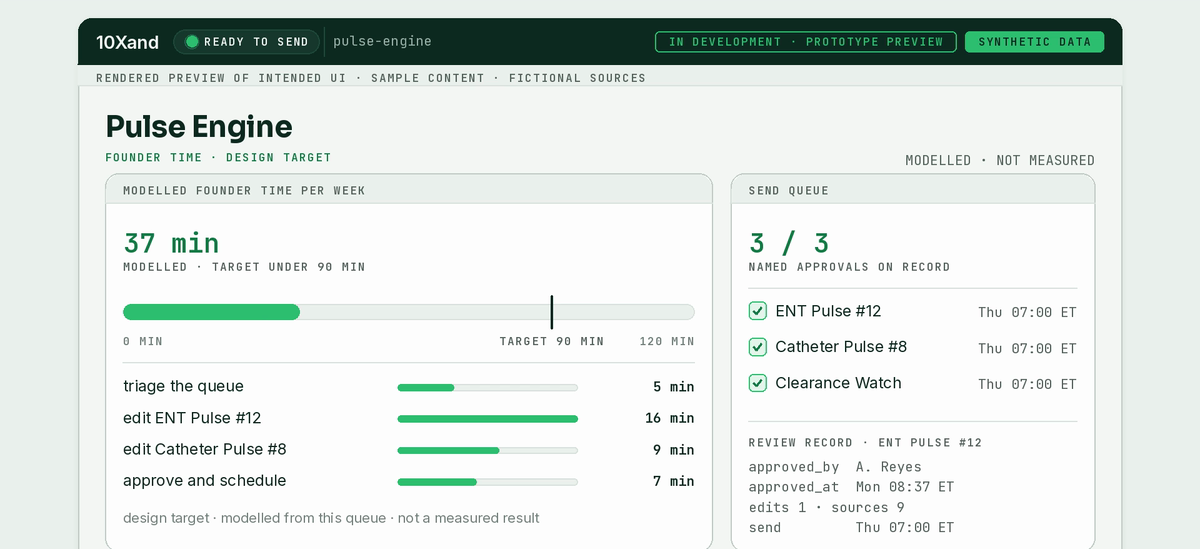
A preview of Pulse Engine, the internal newsletter tool. It shows a modelled founder-time budget of 37 minutes per week against a design target under 90 minutes, explicitly labelled modelled and not measured, broken into triage, editing and approval. A send queue shows three issues with three of three named approvals on record, each with an approval time, editor count and source count in the review record.

Watch it run 1:10

A rendered preview of intended UI, over sample content and fictional sources.

No audio track · every line is captioned on screen · nothing is fetched until you press play

Transcript (14 lines)

The 90-minute figure is a modelled design target. The screen it is spoken over labels it MODELLED, DESIGN TARGET and NOT MEASURED. It is not a measured result, and no week of work has been timed to produce it.
  1. 0:00 A weekly industry brief, drafted overnight.
  2. 0:03 Nothing sends without a name on it.
  3. 0:09 Monday, six a.m. Three briefs are written.
  4. 0:13 The judgment didn't.
  5. 0:20 The editor opens what the machine left behind.
  6. 0:24 Every claim traces back to a cited source.
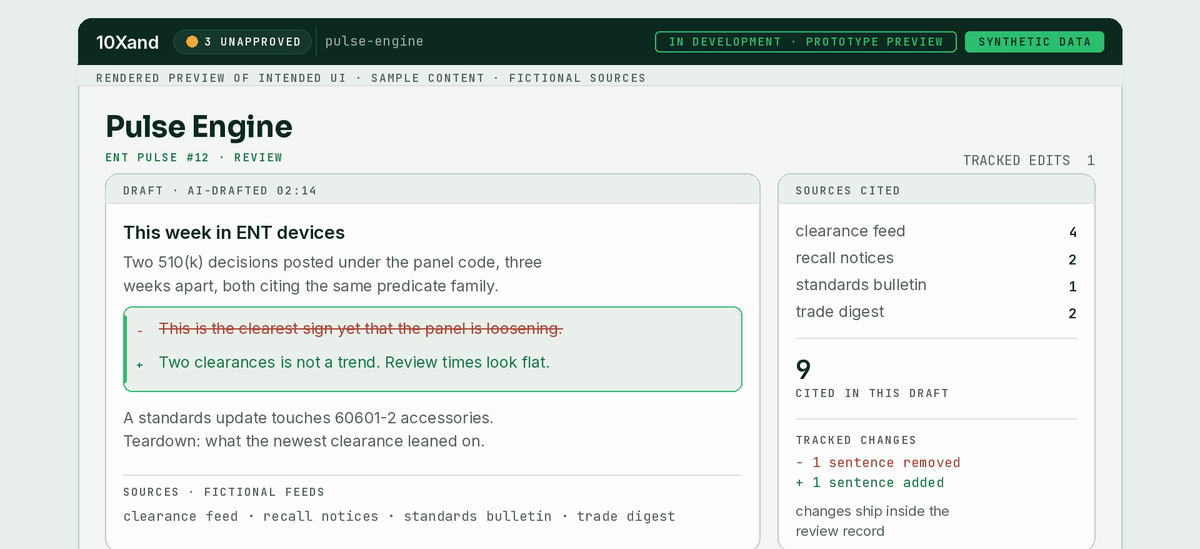
  7. 0:28 Here the draft overclaimed.
  8. 0:32 The editor cuts it, and the cut stays on the record.
  9. 0:40 A named approval, or it does not send.
  10. 0:45 No name on a brief, no send.
  11. 0:49 Every brief approved by a person. The light goes green.
  12. 0:53 Under 90 minutes of founder time a week.
  13. 1:00 The automation does the hours. A human does the judgment.
  14. 1:04 This pipeline is also what we build for clients.
A Pulse Engine draft brief under review, with tracked edits. One sentence — "This is the clearest sign yet that the panel is loosening" — is struck through in red, replaced by "Two clearances is not a trend. Review times look flat." A note reads that the change ships inside the review record, and a counter shows nine cited sources in the draft drawn from fictional feeds.
The draft overclaimed and an editor cut it. The cut itself stays on the record rather than disappearing.
A Pulse Engine panel headed MODELLED FOUNDER TIME PER WEEK showing 37 minutes against a target of under 90 minutes, broken into triage, two editing tasks and approval. The panel is labelled MODELLED and NOT MEASURED, with a footnote reading: design target, modelled from this queue, not a measured result. A send queue beside it shows three of three named approvals on record.
A modelled design target, labelled as one in three separate places on the same screen. Nothing here has been timed.

TOOL-04 Internal tool, sample content, fictional sources. The time figures are a modelled design target and are labelled as such — they are not a measured result.

The offer

The pilot engagement

This is a new service line and we are pricing it to learn: a fixed price for one device class plus three named competitors, quoted at the scoping review.

Intake is limited. The query set is built for your device class rather than run off a template, which is a person’s week, so we take a small number at a time.

One week from the scoping call to the readout. The report is a dated snapshot by design — model behaviour changes, and a number without a date on it would be a false precision.

What you receive

  • A visibility scorecard: presence, accuracy, and framing of your device versus three competitors, per assistant, with the query set published in full.
  • A source map tracing notable answers to the public material behind them.
  • A findings list separating factual errors from framing and from plain absence — three different problems with three different fixes.
  • A prioritised action plan grounded in generative engine optimisation practice, with the sources you control marked as such.
  • The dated raw responses, so you can re-run the same query set later and compare.

What the method section states

  • The exact query set, the assistants covered, and the dates each was run.
  • How many repetitions per query, and the variance observed between them.
  • How source attribution was determined, including where it is inference rather than a cited link.
  • Known limitations: personalisation, region, and model-version effects we could not control for.
10X-SVC-PULSE REV B
What
AI Visibility Report
Price
Fixed
When
1 week

AI-drafted · evidence-cited · human-reviewed

Limited intake

Get the AI Visibility Report one-pager

Method, coverage, and a sample of the scorecard format.

This reaches us as an email and we reply to it — we are not adding you to a mailing list, because we do not run one yet. See the privacy policy.

Questions we get

Which AI assistants are covered?

The major general-purpose assistants clinicians actually reach for, plus the AI answer surfaces now embedded in search. The exact list is stated in the report’s method section and dated, because coverage changes as products launch and change.

How often do these answers change?

Often enough that a single screenshot proves nothing. That is why the method repeats each query across sessions and phrasings and reports the variance, and why the deliverable is explicitly a dated snapshot rather than a standing score. Re-running the same query set later is how you measure whether anything you changed worked.

Is this just SEO?

Related, not identical. Classic SEO optimises for a ranked list of links; this optimises for what a model says when no list is shown. The overlap is that both are driven by public source material — the difference is which sources carry weight, how they are synthesised, and the fact that there is no ranking to inspect. The report deals in what the answers say and where they come from.

What does the deliverable look like?

A scorecard with a row per query and a column per assistant, a source map, a findings list, and an action plan — plus an appendix of the dated raw responses. Roughly the shape of a test report, which is deliberate: it is meant to be re-run and compared, not admired once.

Can we use the findings in marketing?

Carefully, and that is your regulatory call, not ours. The report is informational: it documents what assistants said on a date. Turning any of it into a promotional claim — particularly a comparative one — is subject to your promotional review and the applicable advertising and labelling rules, and the report says so on its face.

What if an assistant says something factually wrong about our device?

The report separates that case from framing problems and from absence, because the fix is different. Factual errors usually trace to a specific public source or to an absence the model filled in; the action plan names the source layer to address and what a correction there would plausibly do. What no one can offer you is a switch that edits the model.