Remediate 10x

A scored DHF gap report in 72 hours. Fixed price.

Audit-ready remediation without the six-month consulting engagement — one device, one design history file, scored and prioritised so your team knows what to fix first.

10X-SVC-REMEDIATE REV B
What
DHF Gap Scan
Price
Fixed, quoted in 24 h
When
72 h to scored report

AI-drafted · evidence-cited · human-reviewed

Why this holds up

01

Built by RA/QA veterans of Class II and Class III programs

The people reviewing your file have written and defended design history files, not just read about them — regulatory affairs, quality systems, and design assurance, on Class II and Class III programs.

02

Checklists derived from the regulation itself

Findings are scored against checklists built from 21 CFR 820 / QMSR and ISO 13485:2016 — public regulation, cited clause by clause. AI accelerates the read; every finding is verified by a named human before it reaches the report.

03

A plan, not a list of complaints

The output is a prioritised remediation plan with an effort estimate against each item, ordered by audit exposure. Your team can execute it, or ours can.

How it works

  1. REM-01

    Scope and NDA

    One device, one DHF. NDA signed before any file moves. We quote a fixed price within 24 hours of the scoping review.

  2. REM-02

    Transfer

    You send the DHF — export, share, or read-only access to your eQMS. We work from what exists, not from a reconstructed ideal.

  3. REM-03

    Scan and score

    Each required element is checked for presence, completeness, traceability, and approval state. Every finding cites the clause it comes from and is scored for audit exposure and effort.

  4. REM-04

    Readout in 72 hours

    A scored report plus a one-hour walkthrough: what to fix first, what can wait, and what is defensible as it stands.

What the work looks like

DHF sections through the gap scan into a scored heatmap Eight design history file sections enter a scan stage. The scan checks each section for presence, completeness, and traceability, and emits a table with one row per section and three scored columns, shaded green for pass, amber for a minor finding, and red for a major one. DHF SECTIONS Design plan Design inputs Design outputs Design reviews Verification Validation Transfer Risk file SCAN presence completeness traceability clause cited SCORED REPORT PRESENT COMPLETE TRACED green = defensible amber = minor finding red = major finding
FIG. 1 DHF sections enter the scan; a scored heatmap comes out. Colour encodes audit exposure, not our opinion of your document quality.

The tool behind this line

GapScan MD

Design preview

Scores every design-control requirement against the clause it comes from, cites the evidence down to document, section and line, and refuses to export until a named reviewer has dispositioned each finding.

A rendered preview of the intended interface. Not running software.

A preview of GapScan MD. A readiness ring shows 76 over a synthetic design history file for a fictional device, with 27 requirements closed, 15 open findings and 3 needing human review. A coverage grid scores 42 requirements across 7 families as pass, partial, missing or cannot assess. One finding opens to show its evidence citation down to document, section and line. The review gate then reads EXPORT BLOCKED with 15 findings unreviewed, a reviewer types their name, dispositions climb to 15 of 15, and the gate turns green reading ALL FINDINGS DISPOSITIONED, REVIEW RECORD COMPLETE, at which point the export button unlocks.

Watch it run 1:12

Working tool

Recorded from a real run of the engine over a synthetic design history file for a device that does not exist. The chrome says so on every frame.

No audio track · every line is captioned on screen · nothing is fetched until you press play

Transcript (14 lines)
  1. 0:00 Before an audit, someone reads the whole file.
  2. 0:04 Usually weeks of reading. One pass.
  3. 0:08 How ready is this file, right now?
  4. 0:12 Synthetic DHF. 15 documents. Fictional device.
  5. 0:18 The file that holds up audits and submissions.
  6. 0:21 One command reads all 15 and sorts them by type.
  7. 0:26 Checked against QMSR design controls. Public sources.
  8. 0:32 12 requirements scored, with confidence and effort.
  9. 0:37 Every finding cites document, section, and line.
  10. 0:43 No evidence, no score. It just says so.
  11. 0:47 Safety-critical items are never scored by the tool.
  12. 0:52 Export attempted with findings unreviewed.
  13. 0:58 A named reviewer signs off on every finding.
  14. 1:04 DHF Gap Scan. Fixed price in 24h, delivered in 72h.

Edited before publishing: Final line trimmed from the recording.

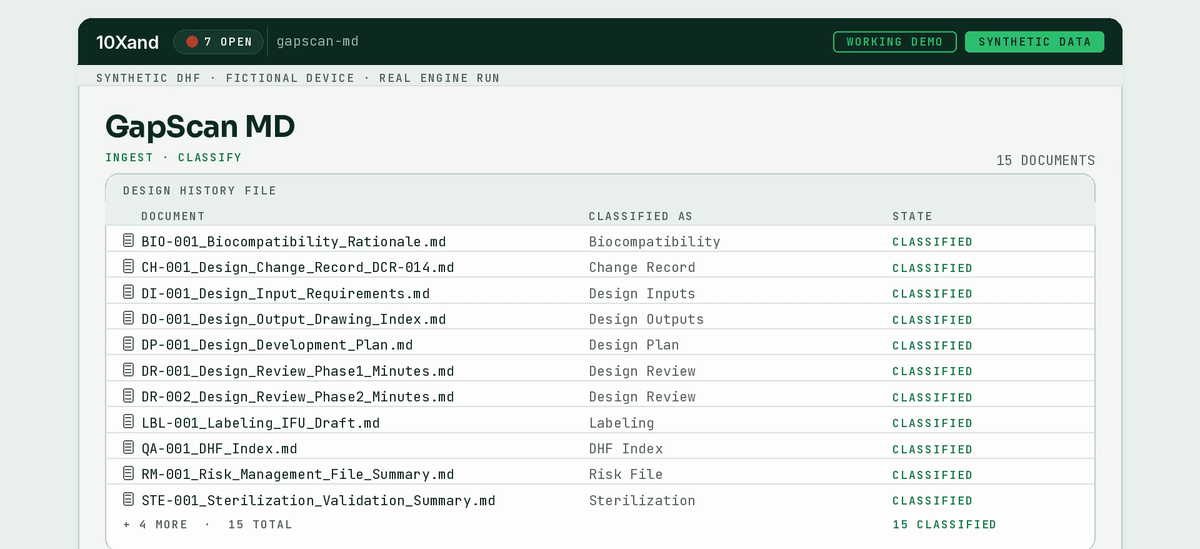
GapScan MD reading a synthetic design history file. Fifteen documents are listed beside the type each was classified as — biocompatibility rationale, change record, design inputs, design outputs, design plan, two sets of design review minutes, a labelling draft, the DHF index, a risk file summary and sterilisation validation — every row marked CLASSIFIED, with a running total of fifteen classified.
Ingest and classify. Every document is sorted by what it is before anything is scored against it.
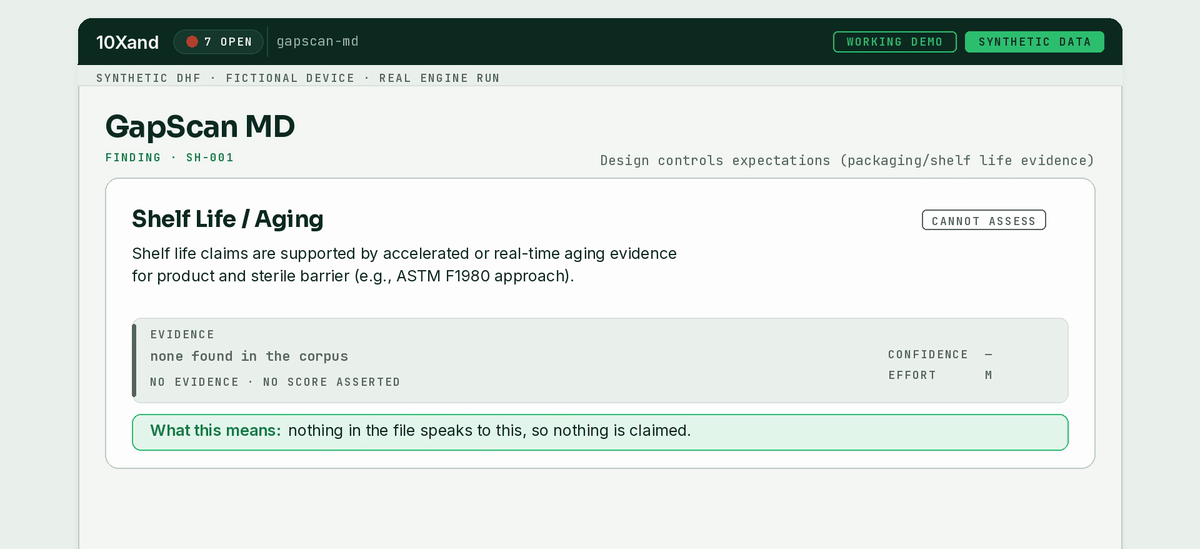
A single GapScan MD finding for Shelf Life and Aging, badged CANNOT ASSESS. The evidence panel reads "none found in the corpus" and "NO EVIDENCE · NO SCORE ASSERTED", with confidence shown as a dash. A plain-language line reads: nothing in the file speaks to this, so nothing is claimed.
The behaviour worth the whole tool. With nothing in the file to cite, it asserts no score and says why — instead of guessing one.
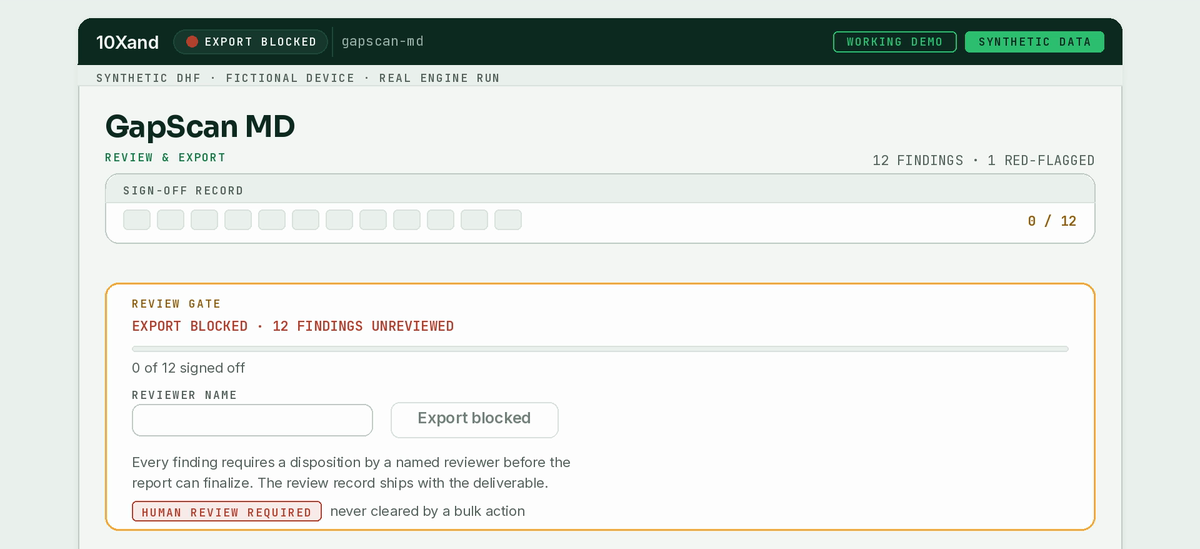
The GapScan MD review gate reading EXPORT BLOCKED, with zero of twelve findings signed off, twelve findings unreviewed and one red-flagged. An empty reviewer name field sits beside the note that every finding requires a disposition by a named reviewer before the report can finalise, and that the review record ships with the deliverable. A line reads HUMAN REVIEW REQUIRED, never cleared by a bulk action.
The export stays blocked until a named person has dispositioned every finding. The review record leaves with the deliverable.

TOOL-01 Synthetic design history file, fictional device. Two moments carry the whole argument: a requirement with no evidence is scored CANNOT ASSESS rather than guessed, and the export stays blocked until a named human has dispositioned every finding.

The offer

The pilot engagement

This is a new service line and we are pricing it to learn: a fixed fee, quoted within 24 hours of the scoping review, for a single-device file.

Intake is limited. We run a small number of these concurrently so the RA/QA reviewers named on your review record are the people actually reading your file. If your file is larger than a single-device scope, we say so at the review rather than after an SOW.

72 hours from transfer to scored report.

What you receive

  • A scored gap report: every required DHF element, its state, the clause it is required by, and a finding score for audit exposure.
  • A prioritised remediation plan with an effort estimate per item and a suggested sequence.
  • A traceability check across design inputs, outputs, verification, validation, and risk.
  • The human-review record (below), and a one-hour readout call.

What the human-review record contains

  • The named reviewer for each DHF section, and the date reviewed.
  • Every AI-surfaced finding that was corrected or withdrawn on human review, with the reason.
  • The clause citation behind every finding that remains.
  • Items we could not assess from the file supplied, listed as open rather than scored.
10X-SVC-REMEDIATE REV B
What
DHF Gap Scan
Price
Fixed, quoted in 24 h
When
72 h to scored report

AI-drafted · evidence-cited · human-reviewed

Limited intake

Get the DHF Gap Scan one-pager

Scope, scoring method, and the file list we need to start. One page.

This reaches us as an email and we reply to it — we are not adding you to a mailing list, because we do not run one yet. See the privacy policy.

Questions we get

What does "scored" actually mean?

Each finding carries two numbers: audit exposure — how likely this is to be cited and how serious the citation would be — and remediation effort. The pair is what makes the report a plan instead of a list. The scoring rubric ships with the report, so your team can re-score a finding they read differently and see exactly which input they changed.

What happens to our file?

It is processed under NDA, held in an access-controlled workspace for the engagement, and deleted or returned on your instruction at the end. Your documents are not used to train any model, and are not shared with any other client. The specific retention and deletion terms are written into the SOW before you send anything.

Are the findings audit-defensible?

Every finding cites the clause it derives from, so it is defensible in the sense that matters: you can trace it to the regulation and argue it on the merits. What we cannot do — and no one honestly can — is guarantee how a particular investigator or notified body will read a particular file. The report is an input to your judgement, not a substitute for it.

How is AI used, and who checks it?

AI does the first read: it locates required elements across the file, flags missing or unapproved items, and drafts the finding text against the checklist. A named RA/QA reviewer verifies every finding before it enters the report, and the review record shows which AI findings were corrected or withdrawn. Nothing reaches you unverified.

What happens after the report?

Three options, and we are explicit that the first is fine by us: your team executes the plan; we execute it as a separate fixed-price engagement; or you use the report to scope the work with whoever you already trust. The scan is not priced as a loss-leader that only pays off if you hire us for the remediation.

Does this extend to post-market files, or only design history?

It extends, as an assessment scope. The same scored-gap discipline applies cleanly to complaint handling under the QMSR (ISO 13485:2016 §8.2.2, incorporated by reference at 21 CFR 820.10): whether complaints are captured from every channel you actually receive them on, whether each record carries the investigation and the justification when no investigation was performed, whether the file links to CAPA and to risk, and whether the reportability decision is documented with its rationale rather than just its outcome. What you get is the same artefact — findings scored for audit exposure and effort, each citing its clause. What does not change is who decides: a reportability call is a named human’s decision on your side, made against your procedure, and nothing in this scope makes or automates that call. Ask us to scope it and we will tell you what a complaint-file assessment would cover for your volume.

Can you scan a file that is mid-remediation?

Yes, and it is a common case. Tell us what is already in flight and the report will separate "not started" from "in progress, not yet approved" rather than scoring your open work as a gap.